
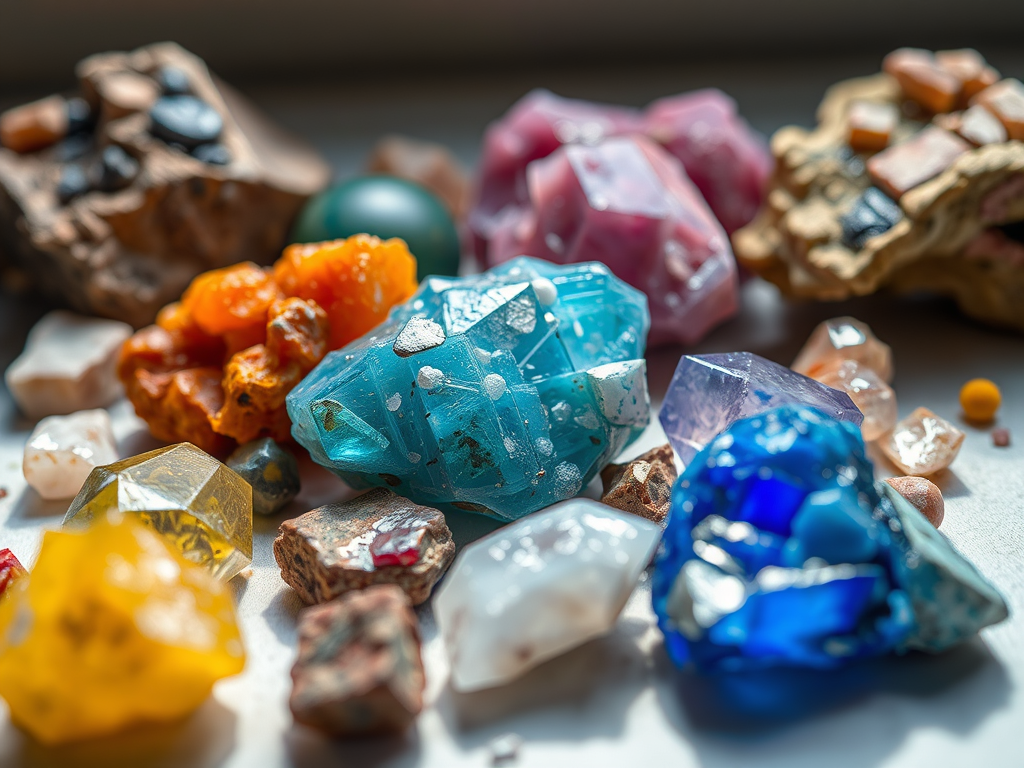
Minerals
What is a Mineral?
A mineral is a naturally occurring inorganic solid with a definite chemical composition and an ordered atomic arrangement. Minerals possess distinct physical properties that allow them to be distinguished from one another. The most important physical properties are as follows:
Physical Properties of Minerals
Colour
Some minerals have a characteristic colour, such as galena, magnetite, and olivine. However, in others, the colour may vary, as seen in quartz.
Specific Gravity
Most rock-forming minerals have a specific gravity between 2 and 4.
Lustre
Lustre refers to the way light reflects off a mineral’s surface. It may be:
- Metallic (e.g., galena, iron pyrites)
- Pearly (e.g., talc)
- Silky (e.g., certain fibrous minerals)
Taste and Smell
Some minerals can be identified by taste or smell, such as rock salt and alum.
Streak
When drawn over a piece of paper or an unglazed porcelain plate, some minerals leave a coloured mark known as a streak. For example:
- Graphite leaves a black streak.
- Hematite leaves a cherry red streak.
Crystallinity
A crystal is a geometric solid bounded by smooth surfaces called faces, which can grow in size by the addition of fresh material. Crystals exhibit a definite geometrical pattern, and the angles between their faces remain constant. Examples of crystal systems:
- Quartz crystallises in the hexagonal system.
- Mica (Muscovite) crystallises in the monoclinic system.
- Rock salt crystallises in the cubic system.
Crystallisation Occurs Through:
- Deposition from a solution
- Slow cooling from a molten state
- Direct transformation from vapour to solid
Cleavage
Some crystals split along one or more directions parallel to an actual or possible crystal face. This splitting forms plane surfaces known as cleavage planes, often occurring at right angles, resulting in perfect cuts.
Fracture
When a crystal breaks independently of cleavage planes, it is said to fracture. This property is prominent in minerals with poor cleavage.
Hardness
Hardness measures the ease with which a mineral can be scratched. It is assessed using Mohs’ scale of hardness, where minerals are ranked from 1 (softest) to 10 (hardest).
Mohs’ Scale of Hardness:
Here’s your table with 3 columns and 10 rows:
| Mohs Hardness | Mineral | Formula |
|---|---|---|
| 1 | Talc | Mg₃Si₄O₁₀(OH)₂ |
| 2 | Gypsum | CaSO₄·2H₂O |
| 3 | Calcite | CaCO₃ |
| 4 | Fluorite | CaF₂ |
| 5 | Apatite | Ca₅(PO₄)₃(OH⁻,Cl⁻,F⁻) |
| 6 | Orthoclase Feldspar | KAlSi₃O₈ |
| 7 | Quartz | SiO₂ |
| 8 | Topaz | Al₂SiO₄(OH⁻,F⁻)₂ |
| 9 | Corundum | Al₂O₃ |
| 10 | Diamond | C |
Observations:
- A fingernail can scratch minerals up to a hardness of 2.5.
- A pen or knife can scratch minerals up to 6.5.
- Window glass can be used as a substitute for apatite when testing hardness.
Protodyaknov Strength Number
In Russia, the hardness of rocks is expressed by the Protodyaknov strength number, indicating the relative ease with which a rock can be broken:
- Weak clay shales and strong lignites: 1.5–2
- Strong coals and anthracite: 2
- Extremely strong quartzites and gabbro-diorites: 20–25 (highest strength)
- Other rocks fall within this range.
Electrical and Magnetic Properties
Some minerals exhibit unique electrical and magnetic properties, which can help distinguish them from others. Additionally, their interactions with light may also provide distinguishing characteristics.




Leave a comment