
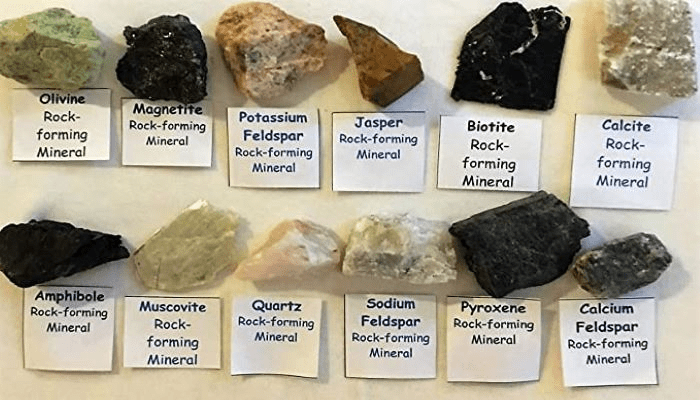
Common Rock-Forming Minerals
- Silicates
- Felspars
Felspars are complex silicates of aluminum with potash, soda, or lime, and are abundant in igneous rocks. Potash felspar, also known as orthoclase, is the most common. It is white, gray, or pink with a glassy luster. When weathered, it forms a hydrated silicate of aluminum called kaolin or china clay. The soda and lime felspars are known as plagioclase, which decompose similarly. Plagioclase felspars are found in most igneous rocks, particularly those rich in lime. Specific gravity: 2.6-2.7, hardness: 6. - Mica
Mica occurs in two varieties: muscovite (white, a silicate of aluminum and potassium) and biotite (black, a silicate of aluminum, iron, and magnesium). Mica can be easily scratched with a fingernail and has well-developed cleavage. It is common in igneous rocks and crystalline schists. Specific gravity: 2.7-3.1, hardness: 2.5. - Hornblende and Augite
These are complex silicates of calcium, magnesium, and iron. Both are greenish-black in color. Hornblende, also known as amphibole, is a dull black mineral that forms six-sided crystals and is found in most igneous rocks. Specific gravity: 3-3.5, hardness: 5-6. Augite, also called pyroxene, is black but more brilliant than hornblende and forms monoclinic crystals. It often alters to chlorite. Specific gravity: 3-3.5, hardness: 5-6. - Olivine (Peridot)
Olivine is a silicate of magnesium and iron found in basic igneous rocks like dolerite, basalt, and peridot. It is greenish and resembles quartz. Specific gravity: 3.2-4, hardness: 6-7. These minerals, containing iron and magnesium, are known as ferromagnesian minerals and are typically found in more basic igneous rocks.
- Felspars
- Oxides
- Quartz (Silica, SiO2)
Quartz is an essential constituent of granite and other acid igneous rocks and a major component of sandstone. It is found in rare occurrences as broken fragments. Specific gravity: 2.6, hardness: 7. - Magnetite (Magnetic Oxide of Iron, Fe3O4)
Magnetite is bluish-black and occurs in earthy forms like red ochre. Its streak is always cherry red. Specific gravity: 4.5-5.3, hardness: 6. - Limonite (Hydrated Ferric Oxide, 2Fe2O3, 3H2O)
Limonite is amorphous, brown or nearly black, and leaves a yellowish-brown streak. Specific gravity: 3.6-4, hardness: 5. - Bauxite (Hydrated Aluminum Oxide, Al2O3, H2O)
Bauxite is a dry white mineral resulting from the weathering of aluminum-bearing rocks under tropical conditions. Specific gravity: 3.5, hardness: 2.5.
- Quartz (Silica, SiO2)
- Carbonates
- Calcite (CaCO3)
Calcite is a key component of marble, chalk, and limestone and effervesces when treated with dilute hydrochloric acid. - Siderite (FeCO3)
Siderite is brown, with a white streak. Specific gravity: 3.7-3.9, hardness: 4. - Dolomite (CaMg(CO3)2)
Dolomite is a carbonate of calcium and magnesium. It constitutes the bulk of limestones and may also be found in igneous rocks. Specific gravity: 3, hardness: 4.
- Calcite (CaCO3)
- Sulphides
- Iron Pyrite (FeS2)
Iron pyrite, also known as fool’s gold, is brass-yellow in color and is sometimes found in coal seams. Its streak is greenish or brownish-black. Specific gravity: 4.1, hardness: 6-6.5. - Galena (PbS)
Galena is gray with a gray streak and a high specific gravity. Specific gravity: 7.2-7.7, hardness: 2.5. - Sphalerite (ZnS)
Sphalerite, also known as blende, typically appears brown or black, with a reddish-brown streak. Specific gravity: 3.9-4.2, hardness: 3.5-4. - Chalcopyrite (Cu2S, Fe2S3)
Chalcopyrite is golden yellow with a greenish-black streak. Specific gravity: 4.1-4.3, hardness: 3.4-4.
- Iron Pyrite (FeS2)
- Sulphates
- Gypsum (Hydrated Calcium Sulphate, CaSO4·2H2O)
Gypsum forms colorless crystals but may appear white or gray. It is used to produce plaster of Paris. Specific gravity: 2.3, hardness: 2.
- Gypsum (Hydrated Calcium Sulphate, CaSO4·2H2O)
- Chlorides
- Rock Salt (NaCl)
Rock salt, or common salt, is colorless or white when pure. Specific gravity: 2.2, hardness: 2.
- Rock Salt (NaCl)
- Other Common Rock-Forming Minerals
- Kaolinite (China Clay, Al2O3·2SiO2·2H2O)
Kaolinite is a hydrated silicate of aluminum. It is a soft, white clay material that crumbles to powder when pressed. Felspars decompose into kaolinite. - Fireclay
Fireclay is any clay or shale that does not fuse below 1580°C, primarily consisting of the mineral Kaolinite. - Fluorspar (CaF2)
Fluorspar can be colorless, purple, green, or yellow, with a vitreous lustre. It occurs in veins of metalliferous ores. Specific gravity: 3, hardness: 4. - Baryte (BaSO4)
Baryte may be white, yellow, red, or blue with a vitreous lustre, commonly found in mineral veins associated with ores of lead and zinc. Specific gravity: 4.5, hardness: 3. - Uranium Oxides
Uranium is used for nuclear energy production. The mined ore contains uranium isotopes U-235 and U-233. The concentrate contains 75% U3O8. - Rare Earth Metals
Rare earth metals, including cerium, lanthanum, erbium, and others, are essential for industrial purposes. Monazite, a phosphate of cerium, is an important source of thorium compounds. Specific gravity: 5.27, hardness: 5.5.
- Kaolinite (China Clay, Al2O3·2SiO2·2H2O)
Here’s a summary of the common rock-forming minerals
| Mineral Group | Minerals | Description | Specific Gravity | Hardness |
|---|---|---|---|---|
| 1. Silicates | Felspars (Orthoclase, Plagioclase) | Complex silicates of aluminum with potash, soda, or lime. Most abundant in igneous rocks. | 2.6 – 2.7 | 6 |
| Mica (Muscovite, Biotite) | A silicate of aluminum and potassium (muscovite) or iron and magnesium (biotite). Common in igneous rocks. | 2.7 – 3.1 | 2.5 | |
| Hornblende (Amphibole) | A complex silicate of calcium, magnesium, and iron. Forms dull black, six-sided crystals. | 3 – 3.5 | 5 – 6 | |
| Augite (Pyroxene) | A complex silicate of calcium, magnesium, and iron. More brilliant than hornblende. Found in basic igneous rocks. | 3 – 3.5 | 5 – 6 | |
| Olivine (Peridot) | A silicate of magnesium and iron, found in basic igneous rocks like basalt and peridot. Greenish in color. | 3.2 – 4 | 6 – 7 | |
| 2. Oxides | Quartz (SiO₂) | Important constituent of granite and acid igneous rocks. | 2.6 | 7 |
| Magnetite (Fe₃O₄) | Bluish-black, magnetic oxide of iron. | 4.5 – 5.3 | 6 | |
| Limonite (2Fe₂O₃·3H₂O) | Hydrated ferric oxide. Brown to black color. | 3.6 – 4 | 5 | |
| Bauxite (Al₂O₃·H₂O) | Hydrated aluminum oxide, results from the weathering of aluminum-bearing rocks. | 3.5 | 2.5 | |
| 3. Carbonates | Calcite (CaCO₃) | Essential in marble, chalk, and limestone. | 2.7 – 2.8 | 3 |
| Siderite (FeCO₃) | Brown, found in iron-rich rocks. | 3.7 – 3.9 | 4 | |
| Dolomite (CaMg(CO₃)₂) | A carbonate of calcium and magnesium. | 2.8 – 2.9 | 3.5 – 4 | |
| 4. Sulphides | Iron Pyrite (FeS₂) | Brass yellow, sometimes found in coal seams. | 4.1 | 6 – 6.5 |
| Galena (PbS) | Grey, common lead ore. | 7.2 – 7.7 | 2.5 | |
| Sphalerite (ZnS) | Brown to black, known as “black jack.” | 3.9 – 4.2 | 3.5 – 4 | |
| Chalcocite (Cu₂S, Fe₂S₃) | Golden yellow, copper pyrite. | 4.1 – 4.3 | 3.4 – 4 | |
| 5. Sulphates | Gypsum (CaSO₄·2H₂O) | Colorless crystals, used in plaster. | 2.3 | 2 |
| 6. Chlorides | Rock Salt (NaCl) | Common salt, colorless or white. | 2.2 | 2 |
| 7. Other Minerals | Kaolinite (China Clay) | A hydrated silicate of aluminum, soft and white, derived from the weathering of felspars. | 2.6 | 1.5 – 2 |
| Fireclay (Kaolinite) | Clay that does not melt below 1580°C, contains kaolinite and various other oxides. | 2.4 – 2.6 | 1.5 – 2 | |
| Fluorspar (CaF₂) | Can be colorless, purple, green, or yellow. Occurs with metalliferous ores. | 3.0 – 3.2 | 4 | |
| Baryte (BaSO₄) | White, yellow, red, or blue. Common in mineral veins associated with ores. | 4.5 | 3 | |
| Uranium Oxides | Uranium used for nuclear energy production. Ore contains small percentages of uranium. | 6.0 – 7.0 | 5 – 6 | |
| Rare Earth Metals | Includes cerium, lanthanum, erbium, and others. Thorium is associated with this group. | 5.0 – 5.5 | 5 – 6 |
This classification of minerals provides key information about their chemical composition, physical properties (like specific gravity and hardness), and how they occur in rocks, particularly in igneous rocks.




Leave a comment