
Types of Rocks
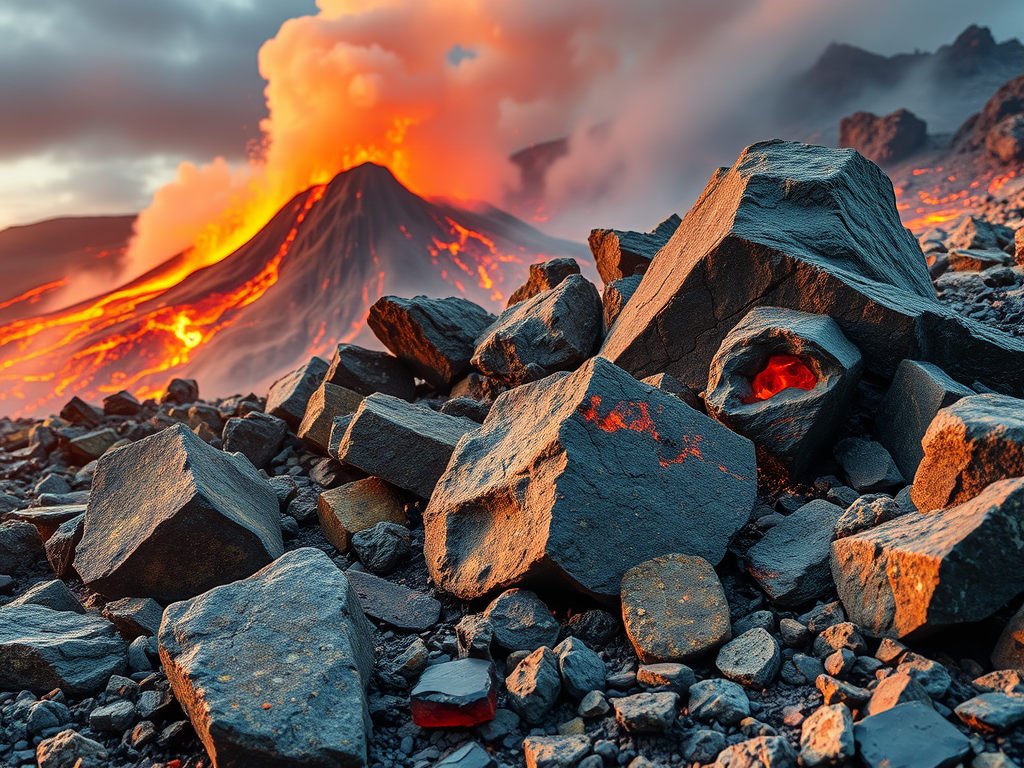
Rocks are divided into three major groups based on their origin and mode of formation:
- Igneous Rocks: These form through the solidification of molten material called magma, which originates from within the Earth.
- Sedimentary Rocks: These are produced mainly by the breakdown of pre-existing rocks and the deposition of the broken material in layers.
- Metamorphic Rocks: These are formed from pre-existing rocks due to high temperatures and pressures.
The Rock Cycle
The rock cycle describes the dynamic transformation of rocks between igneous, sedimentary, and metamorphic forms due to geological processes such as melting, cooling, weathering, erosion, and metamorphism.

Igneous Rocks
Igneous rocks form through the cooling and solidification of magma. Magma is a naturally formed molten mixture of minerals and rocks deep within the Earth. It contains complex silicates and oxides of iron, aluminum, magnesium, calcium, sodium, and potassium, with silica content ranging from 35% to 75%.
Formation of Igneous Rocks
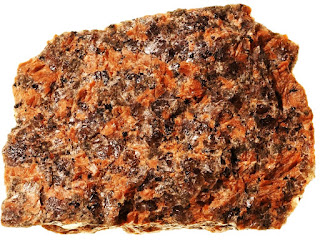
Magma moves upward through zones of lesser pressure and along fissures in existing rocks. When it reaches the surface, it is called lava. The cooling rate and location determine the texture and classification of igneous rocks:
- Plutonic Rocks: Formed deep underground with slow cooling, resulting in large, coarse crystals (e.g., granite).
- Hypabyssal Rocks: Formed at intermediate depths with a moderate cooling rate, leading to smaller crystals (e.g., dolerite).
- Volcanic Rocks: Formed at or near the surface with rapid cooling, resulting in fine-grained or glassy textures (e.g., basalt, obsidian).
Types of Igneous Rock Formations
Igneous rocks occur in different geological formations:
- Batholith: A large, irregular mass of igneous rock that extends deep into the Earth.
- Lopolith: A large, basin-shaped igneous intrusion with decreasing width as depth increases.
- Laccolith: A dome-shaped igneous intrusion that causes the overlying layers to arch upwards.
- Dyke: A vertical, parallel-sided intrusion of magma into pre-existing rock fissures. Dykes can be a few meters to hundreds of meters thick and commonly occur in coalfields, such as the Salma dyke in the Raniganj field and dykes in the Jharia coalfield.
- Sill: A horizontal sheet of igneous rock that intrudes between layers of sedimentary rock, usually fed by a dyke.
- Lava Flows: Extrusive igneous rocks formed by the cooling of lava at the surface, such as the Deccan Traps in India, which are 300 meters thick and cover around 300,000 square kilometers.
Composition and Classification of Igneous Rocks
Igneous rocks are classified based on their chemical composition, particularly silica content:
- Acid Rocks (SiO₂ > 65%): E.g., Granite
- Intermediate Rocks (SiO₂ 55-65%): E.g., Diorite
- Basic Rocks (SiO₂ 45-55%): E.g., Basalt
- Ultra-Basic Rocks (SiO₂ < 45%): E.g., Peridotite
Classification by Texture and Composition
| Acid | Intermediate | Basic | Ultra basic | ||
|---|---|---|---|---|---|
| Plutonic | Granite | Syenite | Diorite | Gabbro | Peridotite |
| Hypabssal | Granite | Syenite | Diorite | Dolerite | |
| Porphyry | Porphyry | Porphyry | |||
| Volcanic | Obsidian | Trachyte | Andesite | Basalt | |
Common Igneous Rocks
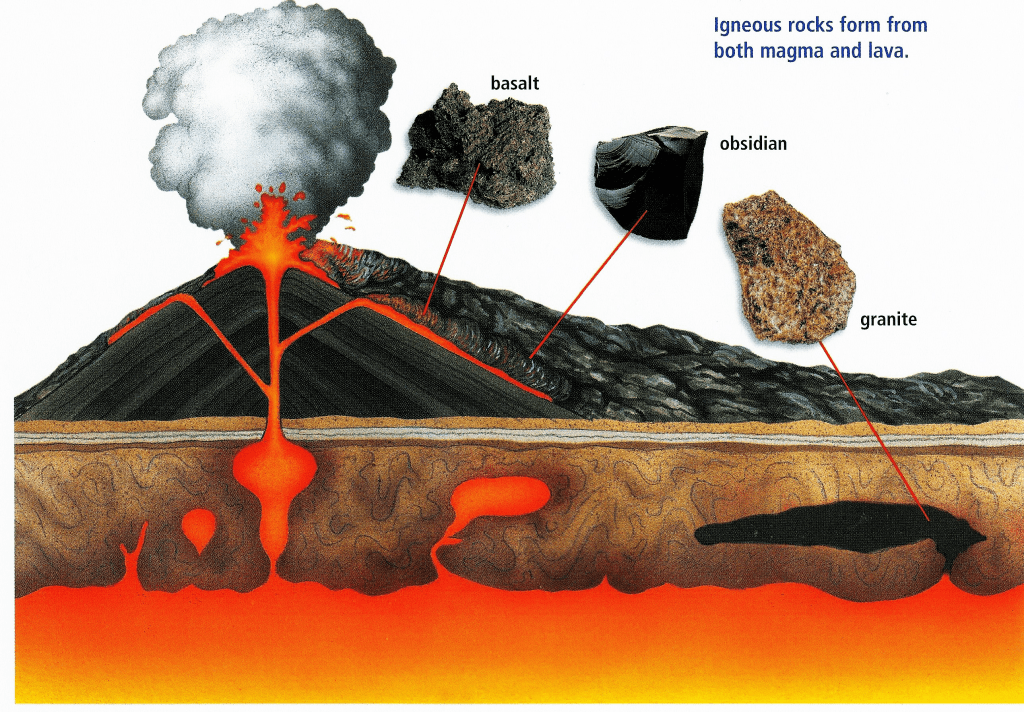
- Granite: Contains quartz, orthoclase feldspar, and biotite mica. Pegmatites, a variety of granite, have very coarse crystals and are found in areas like Kodarma (Bihar).
- Syenite and Diorite: Darker than granite, lacking quartz, and composed of feldspar, biotite, or hornblende.
- Gabbro: Dark, dense rock containing ferromagnesian minerals like olivine and magnetite. Dolerite is a common variety found in dykes and sills.
- Peridotite: Ultra-basic rock composed mainly of olivine, augite, and hornblende, with a high specific gravity (>3). Found in coalfields like Jharia and Raniganj.
Summary
Igneous rocks play a crucial role in Earth’s geology, forming the foundation of continents and oceanic crust. Their classification by texture and composition helps in understanding their formation and applications in construction and industry.




Leave a comment