
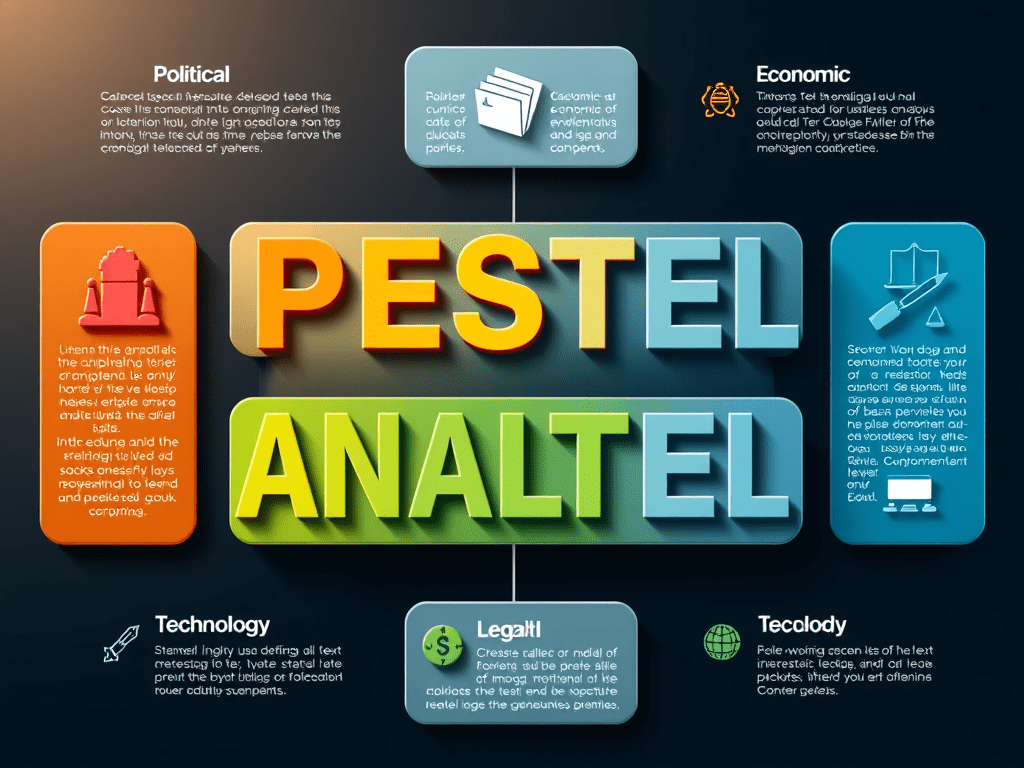
content of table
- 1. Political Factors
- 2. Economic Factors
- 3. Social Factors
- 4. Technological Factors
- 5. Environmental Factors
- 6. Legal Factors
History of PESTEL Analysis
PESTEL analysis was first developed in the 1960s by Harvard professor Francis Aguilar as a framework to analyze external environmental factors that influence businesses. Originally introduced as the ETPS (Economic, Technical, Political, and Social) model, it evolved over time to include additional factors such as Environmental and Legal aspects, leading to the widely used PESTEL (or PESTLE) model today.
The framework has further expanded to include variations like:
- STEEPLE Analysis: Adds Ethics and Discontinuities.
- PESTLE Analysis: Emphasizes Legislative and Environmental factors.
Today, PESTEL analysis is an essential tool for strategic planning, helping organizations assess external risks and opportunities.
Components of PESTEL Analysis
1. Political Factors
- Government regulations
- International relations and trade policies
- Tax policies and tariffs
2. Economic Factors
- Gross Domestic Product (GDP)
- Interest rates and inflation
- Exchange rates and economic stability
3. Social Factors
- Cultural and lifestyle trends
- Demographics (age, gender, income levels)
- Health consciousness and consumer behavior
4. Technological Factors
- Automation and innovation
- Communication and IT advancements
- Research and development (R&D) investment
5. Environmental Factors
- Climate change and sustainability efforts
- Pollution and waste management regulations
- Availability of natural resources
6. Legal Factors
- Employment and labor laws
- Intellectual property rights
- Consumer protection laws and regulations
How to Perform a PESTEL Analysis
- Identify and Analyze Political Factors
- Assess government policies, regulations, and trade restrictions.
- Identify and Analyze Economic Factors
- Study GDP trends, inflation rates, and financial market stability.
- Identify and Analyze Social Factors
- Evaluate demographic trends, cultural shifts, and consumer preferences.
- Identify and Analyze Technological Factors
- Review industry-specific technological advancements and automation.
- Identify and Analyze Environmental Factors
- Examine sustainability practices, climate impact, and environmental laws.
- Identify and Analyze Legal Factors
- Consider regulatory frameworks affecting business operations.
- Analyze the Results
- Assess risks and opportunities to inform strategic decision-making.
Example: PESTEL Analysis of the Beverage Industry in the USA
| Factor | Analysis | Score (out of 10) |
|---|---|---|
| Political | Subject to government regulations on food safety, labeling, and alcohol laws. | 5 |
| Economic | Impacted by GDP growth, unemployment, and inflation rates. | 8 |
| Social | Influenced by health consciousness and demographic trends. | 7 |
| Technological | Advances in manufacturing and packaging automation. | 8 |
| Environmental | Affected by sustainability regulations and climate change concerns. | 6 |
| Legal | Compliance with employment laws, intellectual property, and consumer rights. | 7 |
| Overall Score | Weighted assessment of all factors. | 6.5/10 |
How to Score Factors in PESTEL Analysis
Scoring in PESTEL analysis is subjective and depends on the industry and organization. Factors are usually rated on a scale from 1 to 10 based on:
- Impact Severity: How significantly it affects the business.
- Likelihood of Occurrence: The probability of influencing the industry.
- Relevance to Strategy: Importance in business planning.
Comparison: PESTEL Analysis of the Beverage Industry in Pakistan
| Factor | Score (out of 10) |
|---|---|
| Political | 5 |
| Economic | 8 |
| Social | 6 |
| Technological | 7 |
| Environmental | 7 |
| Legal | 7 |
| Overall Score | 6.7/10 |
Alternative Analysis Frameworks Similar to PESTEL
- SWOT Analysis
- Evaluates internal and external factors by identifying Strengths, Weaknesses, Opportunities, and Threats.
- Porter’s Five Forces
- Analyzes industry competition through:
- Threat of new entrants
- Bargaining power of buyers
- Bargaining power of suppliers
- Threat of substitute products
- Industry rivalry
- Analyzes industry competition through:
- STEEPLE Analysis
- Expands PESTEL by including Ethics and Discontinuities.
Conclusion
PESTEL analysis is a valuable tool for organizations to navigate external factors influencing their industry. By systematically evaluating Political, Economic, Social, Technological, Environmental, and Legal aspects, businesses can make informed strategic decisions and adapt to changing market conditions effectively.







Leave a comment