
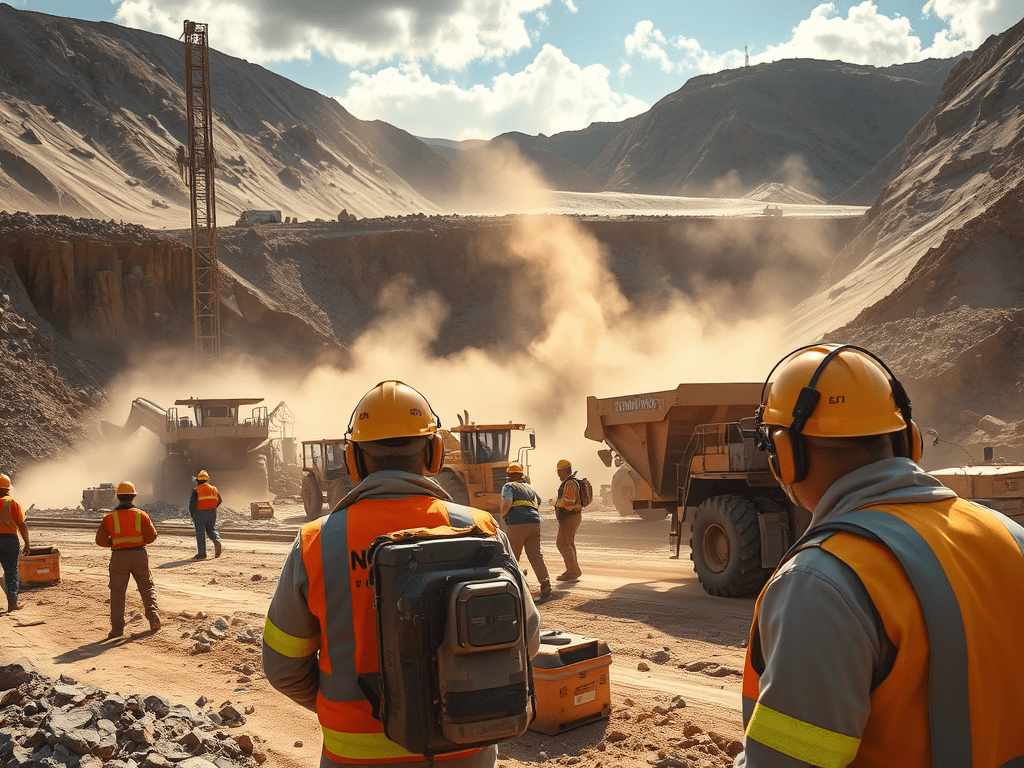
Introduction
Noise pollution is a significant environmental and occupational concern in mining operations. The combined noise from blasting, drilling, hauling, and crushing equipment can reach hazardous levels, affecting workers’ health and nearby communities. Understanding how to measure and calculate total noise levels is essential for implementing effective noise control strategies.
Understanding Noise Levels
Noise levels are measured in decibels (dB) on a logarithmic scale. Unlike regular arithmetic addition, sound energy accumulates logarithmically. This means that adding two noise sources of equal intensity does not double the decibel value but results in a slightly higher total noise level.
Formula for Total Noise Level
The total noise level from multiple sources is calculated using the following logarithmic equation:
Where:
- Ltotal = Total noise level (dB)
- Li = Noise level of individual sources (dB)
- n = Number of noise sources
Example Calculation
Consider a mining site with the following noise sources:
- Blasting: 120 dB
- Drilling: 100 dB
- Haul Trucks: 95 dB
- Crushers: 105 dB
Using the formula:
Breaking it down:
Thus, the total noise level at the mining site is approximately 120.3 dB.
Implications of Noise Levels in Mining
- Occupational Health Risks: Continuous exposure to high noise levels can lead to hearing loss, tinnitus, and increased stress among workers.
- Environmental Impact: Wildlife near mining operations may experience disrupted communication, altered behavior, and habitat displacement.
- Regulatory Compliance: Many countries enforce strict noise limits in industrial settings, requiring monitoring and mitigation strategies.
Noise Reduction Strategies
- Engineering Controls: Use of soundproof enclosures, vibration isolators, and quieter machinery designs.
- Administrative Controls: Implementing rotational shifts and noise scheduling to limit exposure.
- Protective Equipment: Providing miners with earplugs and noise-canceling earmuffs.
- Monitoring and Compliance: Regular noise level assessments using decibel meters to ensure adherence to safety regulations.
Conclusion
Calculating noise levels in mining is crucial for worker safety, environmental protection, and regulatory compliance. By applying logarithmic noise calculations, mining companies can better assess risks and implement effective noise control measures.
Keywords
Noise pollution, mining noise, noise level calculation, decibel measurement, logarithmic scale, occupational health, blasting noise, mining safety, noise reduction, environmental impact, industrial noise control.







Leave a comment