

Introduction
What is Mining?
Mining is the process of excavating minerals of economic value from the Earth’s crust for the benefit of mankind. The Earth’s crust, the outermost layer of the Earth, extends to depths of 30 to 50 km and includes land, oceans, lakes, and rivers. However, for mining operations, only the uppermost 5 km of the Earth’s crust is of practical interest. A fundamental understanding of geology is essential for effective mining operations.
What is Geology?
Geology is the science of the Earth, studying the origin, structure, and composition of rocks. Mining geologists focus on the thin surface layers of rock, helping to locate and assess the most economical sites for mining or quarrying.
Minerals and Rocks
In geology, the terms minerals and rocks have distinct meanings:
- Mineral: A naturally occurring, homogeneous substance with a definite chemical composition and specific physical properties. Examples include quartz (SiO₂), hematite (Fe₂O₃), and galena (PbS).
- Rock: A natural aggregate of minerals. Some rocks consist of a single mineral, while others contain multiple minerals. For example, granite is a rock composed of quartz, feldspar, and mica.
Key Differences Between Minerals and Rocks:
| Feature | Mineral | Rock |
|---|---|---|
| Composition | Definite chemical formula | Variable mineral composition |
| Structure | Crystalline structure | Aggregate of minerals |
| Example | Quartz (SiO₂), Galena (PbS) | Granite, Basalt |
Important Geological Terms in Mining
Bedrock
Bedrock refers to solid rock that lies in its original, undisturbed position beneath soil and loose materials.
Country Rock
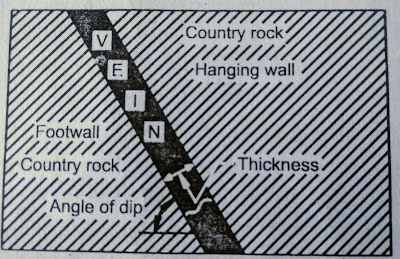
The country rock is the predominant rock surrounding an orebody. It forms both the footwall (below the orebody) and the hanging wall (above the orebody).
Seam
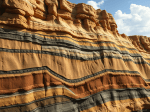
A seam is a mineral deposit confined between two parallel layers, commonly found in sedimentary rocks. This term is widely used in coal mining, e.g., coal seam.
Gangue and Waste Rock
- Gangue: The unwanted minerals and rock that must be removed to extract the desired mineral (used in metal mining).
- Waste Rock/Dirt/Rejection: The non-economic material removed in coal mining.
Ore and Orebody
- Ore: A rock containing valuable minerals that can be economically extracted after processing.
- Orebody: The specific portion of a vein that contains extractable ore.
- Straight Ore: An ore that contains only one metal after processing.
Mineral Deposits
A mineral deposit is a naturally occurring accumulation of minerals that has economic value and justifies extraction.
Veins and Lodes
- Vein (Lode): A crack in the Earth’s crust filled with minerals. These minerals can precipitate from mineral-rich fluids, crystallize from magma, or form from gases.
- Compound Lodes: A set of nearly parallel veins.
- Strike, Dip, and Thickness: These terms define the orientation and shape of a vein but often vary within the same vein.
Structural Relationship in a Mining Site:
- The country rock contains the vein.
- The vein contains the orebody.
- The orebody contains the ore.
- The ore contains the mineral.
- The mineral contains the metal(s).
Conclusion
Understanding geological terms and concepts is crucial in mining geology as it aids in identifying valuable mineral deposits, optimizing extraction processes, and ensuring economic feasibility.
Keywords:
mining geology, minerals and rocks definition in mining, difference between rock and mineral, bedrock, seam, coal seam, country rock, vein, orebody, ore, mineral contains the metal or metals.



Leave a comment