
Table of Content
- Key Points
- What is Uranium?
- Isotopes and Nuclear Properties
- Health and Safety
- Uses and Production
- Survey Note: Comprehensive Analysis of Uranium
Key Points
- Uranium is a silvery-grey metal, atomic number 92, used in nuclear power and weapons.
- It has two main isotopes: U-238 (99.28%) and U-235 (0.72%), with U-235 being fissile.
- Uranium is weakly radioactive, with health risks mainly from ingestion or inhalation, causing kidney damage and potential cancer.
- Surprisingly, external exposure is less dangerous as skin blocks alpha particles, but internal exposure is harmful.
What is Uranium?
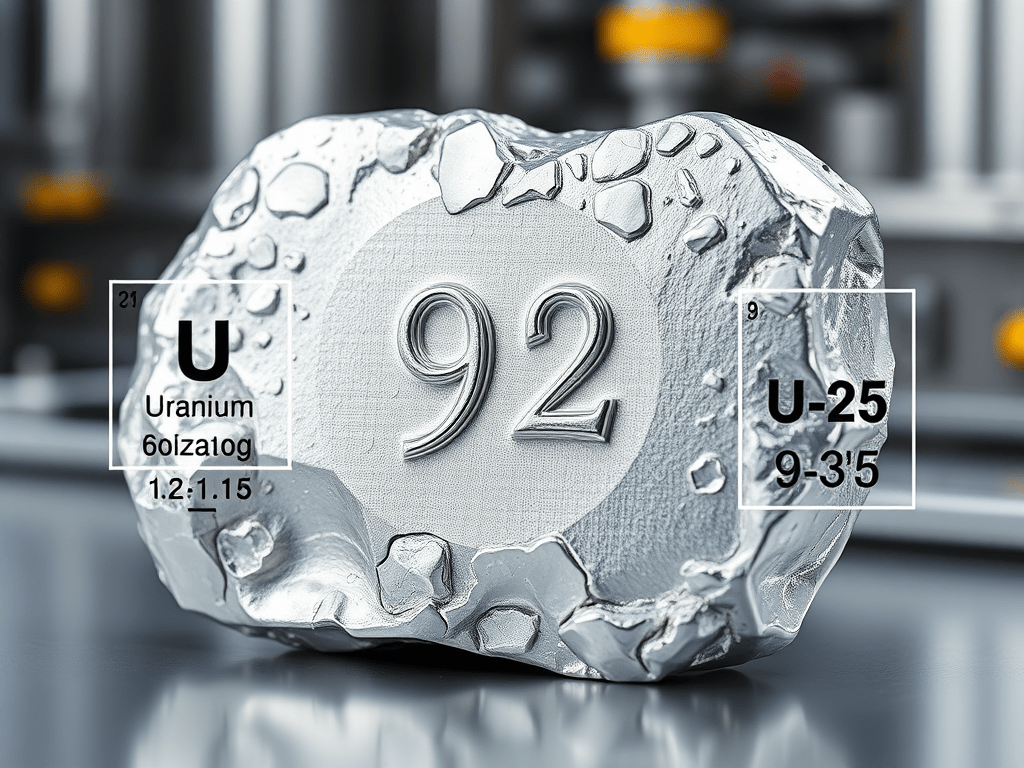
Uranium is a chemical element with the symbol U and atomic number 92, meaning each atom has 92 protons. It’s a silvery-grey metal in the actinide series of the periodic table, known for its role in nuclear energy and weapons. Uranium occurs naturally in low concentrations in soil, rock, and water, and is extracted from minerals like uraninite.
Isotopes and Nuclear Properties
Uranium has three main naturally occurring isotopes: U-238, U-235, and U-234. U-238 makes up about 99.28% and is not fissile but fertile, meaning it can be converted to plutonium-239 (Pu-239) in reactors. U-235, at 0.72%, is fissile, meaning it can sustain a chain reaction, making it essential for nuclear reactors and weapons after enrichment. U-234 is present in trace amounts (0.0054%).
Health and Safety
Uranium is weakly radioactive, decaying by emitting alpha particles. External exposure is less dangerous because skin blocks alpha particles, but ingestion or inhalation can cause severe health effects. It’s chemically toxic, potentially damaging kidneys, and can lead to cancers like bone or liver cancer over time due to internal radiation exposure.
Uses and Production
Uranium is crucial for nuclear power plants, where U-235 is enriched to 3-5% for fuel. For weapons, it’s enriched to over 90% U-235, a process called producing weapon-grade uranium, typically using gas centrifuges. This high enrichment is what makes it suitable for nuclear bombs.
Survey Note: Comprehensive Analysis of Uranium
Uranium, a chemical element with the symbol U and atomic number 92, is a silvery-grey metal belonging to the actinide series of the periodic table. This element is significant for its nuclear properties, making it a cornerstone in energy production and military applications. The following sections provide a detailed examination of its properties, isotopes, health effects, and production processes, based on extensive research and verification.
Chemical and Physical Properties
Uranium has 92 protons and 92 electrons, with 6 valence electrons, contributing to its chemical reactivity. It has the highest atomic weight among primordially occurring elements, with a density about 70% higher than lead and slightly lower than gold or tungsten. Naturally, it occurs in low concentrations, a few parts per million, in soil, rock, and water, and is commercially extracted from uranium-bearing minerals such as uraninite (Uranium – Element information, properties and uses | Periodic Table).
Isotopic Composition and Nuclear Characteristics
Uranium’s isotopic composition is critical to its applications. The three primary naturally occurring isotopes are:
- Uranium-238 (U-238): Comprising approximately 99.28% of natural uranium, it has 146 neutrons and a half-life of about 4.47 billion years. It is not fissile but fertile, meaning it can capture a slow neutron and, after two beta decays, become fissile plutonium-239 (Pu-239). U-238 is fissionable by fast neutrons but cannot sustain a chain reaction due to inelastic scattering reducing neutron energy (Uranium – Wikipedia).
- Uranium-235 (U-235): Making up about 0.72%, it has 143 neutrons and a half-life of 704 million years. U-235 is fissile, capable of sustaining a fission chain reaction, and is the only primordial nuclide found in significant quantities that can do so. Its nuclear cross-section for slow thermal neutrons is about 504.81 barns, and for fast neutrons, it’s around 1 barn. It was discovered in 1935 by Arthur Jeffrey Dempster (Uranium – Wikipedia).
- Uranium-234 (U-234): Present in trace amounts (0.0054%), it is also radioactive but less significant in natural abundance.
These isotopes’ half-lives, particularly U-238 (4.47 billion years) and U-235 (704 million years), make them useful for dating the age of the Earth, as their decay rates provide a chronological marker (Nuclear Fuel Facts: Uranium | Department of Energy).
Health Effects and Safety Concerns
Uranium’s radioactivity and chemical toxicity pose health risks, primarily through ingestion or inhalation rather than external exposure. It decays by emitting alpha particles, which are blocked by skin, making external exposure less dangerous. However, internal exposure is hazardous:
- Chemical Toxicity: Uranium is a toxic chemical, and ingestion can cause kidney damage due to its chemical properties, often manifesting before radioactive effects lead to cancers (Health Effects of Uranium | US EPA).
- Radiological Effects: Inhaling large concentrations can lead to lung cancer from alpha particle exposure inside the body. Ingestion of high concentrations may cause cancers of the bone or liver over time, as absorbed uranium deposits in bones, liver, and kidneys, with 66% found in bones and a half-life in bones of 70–200 days (PUBLIC HEALTH STATEMENT FOR URANIUM – Toxicological Profile for Uranium – NCBI Bookshelf).
The distinction between chemical and radiological effects is crucial, with chemical toxicity often predominant for chronic low-dose exposure, especially in environmental scenarios (Emerging health risks and underlying toxicological mechanisms of uranium contamination – ScienceDirect).
Nuclear Applications and Enrichment
Uranium’s nuclear properties are exploited in power generation and weaponry:
- Nuclear Power: U-235 is enriched to 3-5% for use in light water reactors, while heavy water and graphite-moderated reactors can use unenriched uranium. The enrichment process removes some U-238, increasing the proportion of U-235 (Uranium | Definition, Properties, Uses, & Facts | Britannica).
- Nuclear Weapons: Weapon-grade uranium is highly enriched uranium (HEU) with U-235 concentration greater than 90%. This is achieved through uranium enrichment, typically using gas centrifuge technology, which separates U-235 from U-238 based on their mass difference. The process involves converting uranium ore to uranium hexafluoride gas, then feeding it into centrifuges to increase U-235 concentration (Weapons-grade uranium process explained | Iran | The Guardian).
The production of weapon-grade uranium is sensitive due to proliferation concerns, with international agreements tightly supervising enrichment plants (Uranium Enrichment – World Nuclear Association).

Detailed Isotopic Data
To organize the isotopic information, the following table summarizes key properties:
| Isotope | Natural Abundance (%) | Half-Life | Neutrons | Protons | Fissile/Fertile | Key Use |
|---|---|---|---|---|---|---|
| U-238 | 99.28 | 4.47 billion years | 146 | 92 | Fertile | Converts to Pu-239 in reactors |
| U-235 | 0.72 | 704 million years | 143 | 92 | Fissile | Nuclear reactors, weapons (enriched) |
| U-234 | 0.0054 | 245,500 years | 142 | 92 | Not significant | Trace, used in dating |
This table highlights the dominance of U-238 and the critical role of U-235 in nuclear applications.
Conclusion
Uranium’s role in nuclear technology is underpinned by its isotopic composition, with U-235 being central to fission reactions and U-238 supporting fertile conversion. Its health risks are significant internally, particularly through chemical toxicity to kidneys and potential cancer risks. The production of weapon-grade uranium involves advanced enrichment, highlighting its strategic importance and the need for international oversight.
Key Citations:
- Uranium – Element information, properties and uses | Periodic Table
- Uranium – Wikipedia
- Health Effects of Uranium | US EPA
- Weapons-grade nuclear material – Wikipedia
- Enriched uranium – Wikipedia
- Nuclear Fuel Facts: Uranium | Department of Energy
- Uranium | Definition, Properties, Uses, & Facts | Britannica
- PUBLIC HEALTH STATEMENT FOR URANIUM – Toxicological Profile for Uranium – NCBI Bookshelf
- Emerging health risks and underlying toxicological mechanisms of uranium contamination – ScienceDirect
- Weapons-grade uranium process explained | Iran | The Guardian
- Uranium Enrichment – World Nuclear Association






Leave a comment