
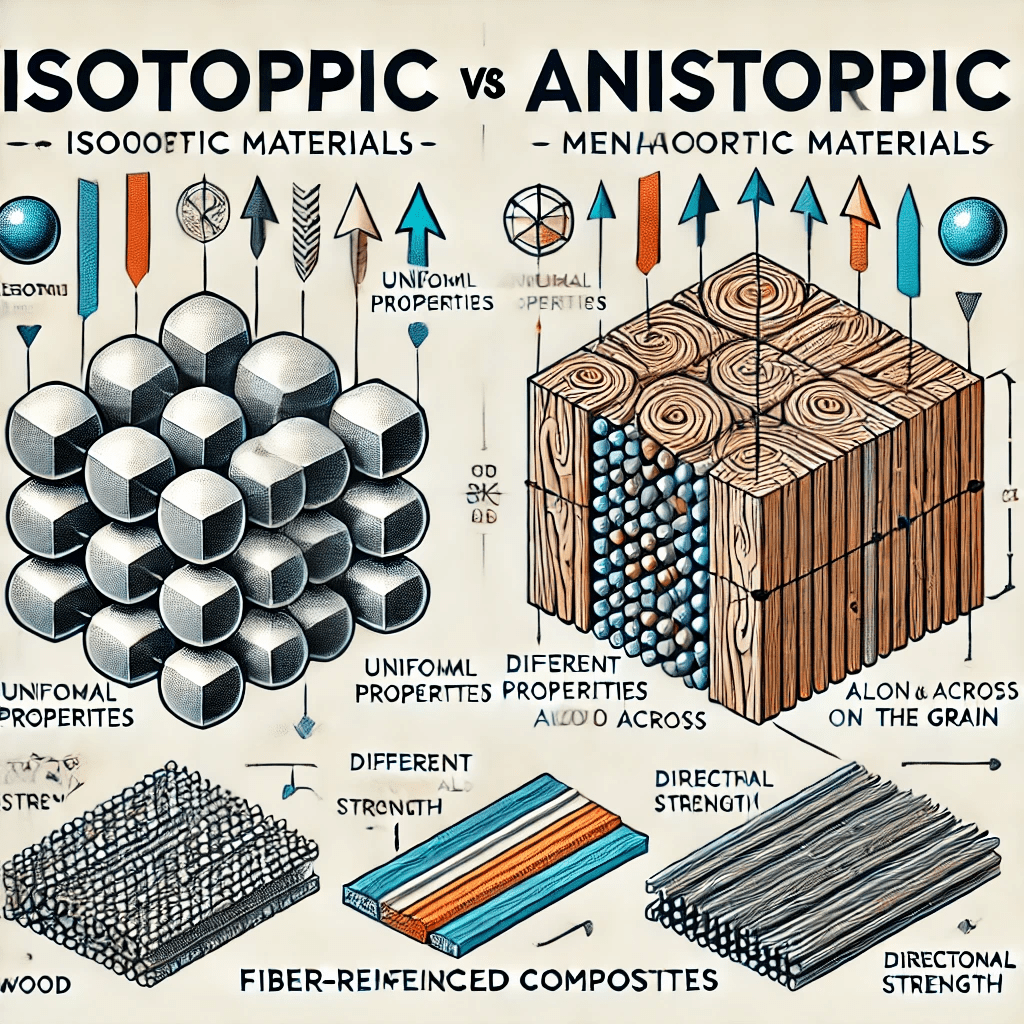
Isotropic materials have identical physical properties in all directions, while anisotropic materials exhibit different properties depending on direction.
An isotropic material maintains consistent strength, stiffness, and other properties regardless of the direction in which it is loaded or measured. For example, steel is isotropic because its mechanical properties remain the same in all directions.
In contrast, anisotropic materials possess varying properties in different directions. Wood, for instance, is anisotropic because its strength and stiffness differ along the grain compared to perpendicular to the grain.
Another example is fiber-reinforced composites, which consist of fibers (such as carbon or glass) embedded in a matrix (such as resin). These fibers enhance strength and stiffness along their alignment, making the composite anisotropic in that direction.
In summary, isotropy refers to uniform properties in all directions, whereas anisotropy signifies directional variation in material properties.
Tags: isotropic, anisotropic, materials, strength, stiffness, wood, steel, composites, fiber-reinforced







Leave a comment