
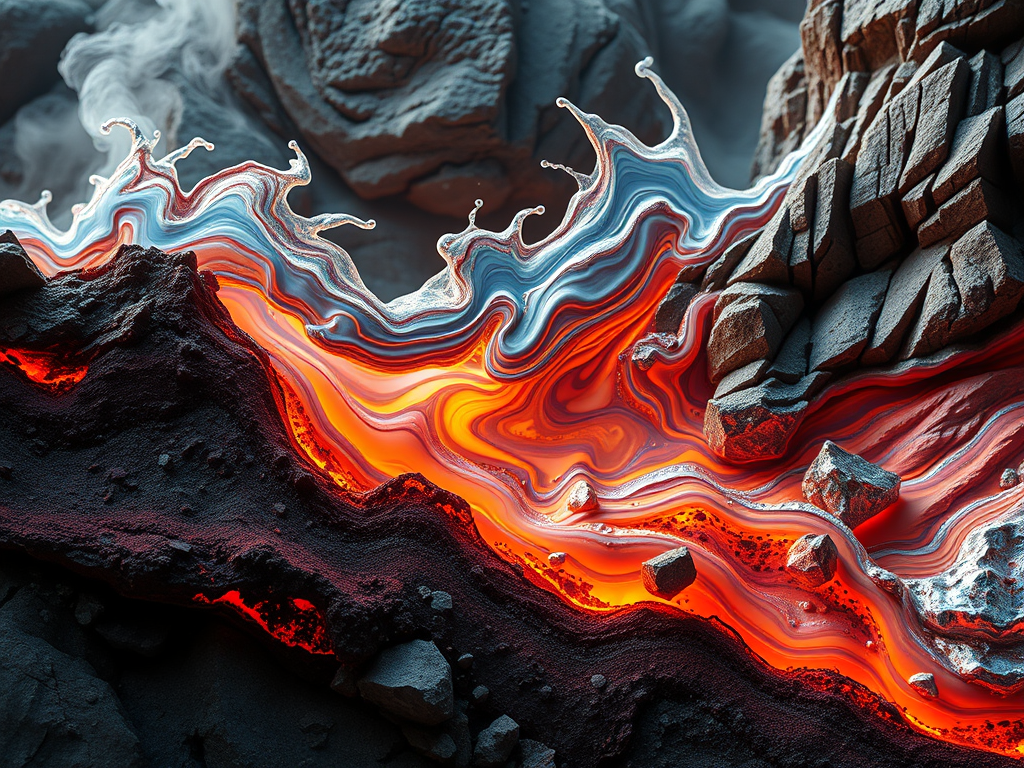
Introduction to Deposit Formation and Transformation
The formation of most of the Earth’s mineral resources involves the presence of a fluid phase that extracts ore elements from their host rocks by dissolution. This fluid phase promotes transport (mechanical and/or chemical) and ultimately deposits these elements in suitable locales. Consequently, understanding the fluid phase is crucial for developing accurate models of ore genesis. These fluids, which can vary widely in composition, temperature, physical state, and flow characteristics, represent a state of matter where molecules can flow past one another without limit, fracture, or dislocation. The physical state—whether gas, vapor, or liquid—reflects progressively closer molecular association and is characterized by distinct mechanical and thermodynamic properties.
To understand the genesis of ores, it is essential to characterize the fluids and gain precise information about the magmatic, hydrothermal, tectonic, and sedimentary events that produce the ore-forming crustal fluids and metal sources responsible for these economic mineral deposits. This approach forms the foundation of ore genetic studies. Many ore deposits form at depth in the endogenous environment, driven by Earth’s internal heat and its dissipation. Over time, these deposits are exhumed or brought close to the surface, either by erosion of the overlying material or tectonic uplift, or both. Additionally, a significant number of economically important mineral deposits form in the exogenous environment, where weathering and sedimentation—dominant geological processes in water-dominated systems—are influenced by solar heat flux, and biological mediation is common. Between these two extremes, various processes contribute to the formation and transformation of ore deposits.




Leave a comment