
Uranium Deposit Types and Their Geologic Settings
Uranium deposits are classified based on their geologic settings, and each type forms under different conditions in specific rock types and ages. Here are the main types of uranium deposits and their common geologic settings:
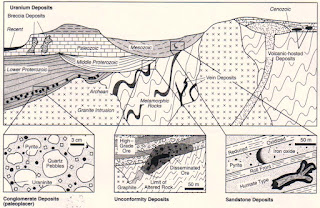
1. Sandstone-hosted Uranium Deposits
- Geologic Setting: These deposits form in sedimentary rocks, particularly in sandstone or conglomerates. They are often found in aquifers where groundwater circulation plays a significant role in uranium deposition.
- Host Rocks: Sandstone, conglomerate
- Age: Typically found in rocks of Permian to Cretaceous age (though some deposits are also found in younger rocks).
- Formation Process: Uranium is transported by groundwater, typically in the form of uranyl ion complexes, which precipitate when chemical conditions such as pH and oxidation-reduction potential change.
2. Quartz-pebble Conglomerate Deposits
- Geologic Setting: These deposits are often found in alluvial fan or fluvial (river) settings, where uranium is concentrated in conglomerate beds containing quartz pebbles.
- Host Rocks: Quartz-pebble conglomerates, breccias
- Age: Usually associated with Precambrian to Paleozoic age rocks.
- Formation Process: Uranium is usually transported by water and deposited in porous sedimentary rock layers.
3. Unconformity-associated Uranium Deposits
- Geologic Setting: These deposits occur at unconformities (where older rock layers meet younger ones), typically in the sandstone, limestone, or shale beds overlying the older, uranium-rich rocks.
- Host Rocks: Unconformities between Proterozoic and Phanerozoic rocks, often in quartzite, sandstone, and shale.
- Age: Often associated with Proterozoic rocks, sometimes extending into Paleozoic and Mesozoic rocks.
- Formation Process: Uranium is often transported and concentrated by hydrothermal fluids along the unconformity surfaces.
4. Limestone-hosted Uranium Deposits
- Geologic Setting: These deposits are found in carbonate rocks such as limestone or dolomite in sedimentary basins.
- Host Rocks: Limestone, dolomite, calcareous rocks
- Age: Found in rocks of Paleozoic and Mesozoic age.
- Formation Process: Uranium is typically carried by groundwater and precipitates in the limestone when the water’s chemistry changes.
5. Granite-related Uranium Deposits
- Geologic Setting: These deposits occur in or around granite intrusions and pegmatites (coarse-grained granite).
- Host Rocks: Granite, pegmatite, schist
- Age: Mostly associated with Precambrian rocks, particularly in regions with older granite formations.
- Formation Process: Uranium is found in hydrothermal veins and fracture zones within the granite, which can be concentrated through later mineralization.
6. Volcanic-hosted Uranium Deposits
- Geologic Setting: These deposits occur in volcanic rocks, particularly rhyolite or tuff (volcanic ash), often in areas with past or present volcanic activity.
- Host Rocks: Rhyolite, tuff, basalt
- Age: Associated with Tertiary and Cenozoic volcanic rocks.
- Formation Process: Uranium is carried by volcanic gases and hydrothermal fluids, often precipitating from these fluids as the rock cools and undergoes mineralization.
7. Boulder-hosted Uranium Deposits
- Geologic Setting: Found in gravel deposits or boulders within sedimentary basins that contain uranium deposits as a result of erosion and deposition.
- Host Rocks: Gravel, boulders
- Age: Typically associated with Tertiary to Cenozoic rocks.
- Formation Process: Uranium-bearing material is eroded from older deposits and redeposited into gravel or boulder fields, where it becomes concentrated.
8. Molybdenum- and Uranium-associated Vein Deposits
- Geologic Setting: These deposits are found in hydrothermal veins and breccias, often associated with granite or porphyry systems.
- Host Rocks: Granite, porphyry, breccia
- Age: Often found in Cenozoic and Mesozoic systems.
- Formation Process: Uranium is deposited along with molybdenum and other metals in veins formed by circulating hydrothermal fluids.
Summary of Uranium Deposit Types and Host Rocks
| Deposit Type | Host Rocks | Age Range | Formation Process |
|---|---|---|---|
| Sandstone-hosted | Sandstone, conglomerate | Permian to Cretaceous | Groundwater precipitation of uranium |
| Quartz-pebble Conglomerate | Quartz-pebble conglomerates, breccia | Precambrian to Paleozoic | Water transport and deposition in sediments |
| Unconformity-associated | Unconformities between Proterozoic and Phanerozoic | Proterozoic | Uranium concentrated along unconformity surfaces |
| Limestone-hosted | Limestone, dolomite, calcareous rocks | Paleozoic to Mesozoic | Groundwater precipitates uranium in limestone |
| Granite-related | Granite, pegmatite, schist | Precambrian | Hydrothermal fluids deposit uranium in granite |
| Volcanic-hosted | Rhyolite, tuff, basalt | Tertiary to Cenozoic | Uranium precipitation from volcanic fluids |
| Boulder-hosted | Gravel, boulders | Tertiary to Cenozoic | Erosion and deposition of uranium in sediments |
| Molybdenum- and Uranium-associated | Granite, porphyry, breccia | Cenozoic to Mesozoic | Vein deposition of uranium with molybdenum |
These uranium deposits reflect the various conditions that lead to the concentration of uranium in certain geological settings, ranging from sedimentary to igneous and metamorphic environments.




Leave a comment