

Exsolution
In mineralogy, exsolution is a process through which an initially homogeneous solid solution separates into at least two different crystalline minerals without the addition or removal of any materials. This phenomenon typically occurs when a mineral cools below the temperature at which its components are mutually soluble. As the temperature decreases, the initially uniform mineral structure becomes unstable, causing different mineral phases to segregate.
A common example of exsolution is observed in feldspar minerals. The sodium-rich feldspar albite (NaAlSi₃O₈) and the potassium-rich feldspar orthoclase (KAlSi₃O₈) can form a homogeneous solid solution at high temperatures above 650°C (1,200°F). However, upon cooling below this threshold, exsolution occurs, leading to the formation of intergrown lamellae or streaks of the two feldspars within a single crystal. This process is crucial in geology as it influences the texture and appearance of many igneous and metamorphic rocks.
Orogeny
Orogeny refers to a mountain-building event that typically takes place in geosynclinal regions. Unlike epeirogeny, which involves broad, vertical movements of the Earth’s crust over long geological periods, orogeny occurs over a relatively short geological time scale and is concentrated along linear belts. It results in intense structural deformation, leading to the formation of mountain ranges.
Key geological processes associated with orogeny include:
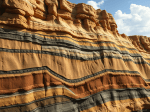
- Folding and Faulting: The compression of rock layers due to tectonic forces leads to the formation of folds and faults, altering the structure of the crust.
- Angular Unconformities: These interruptions in the normal deposition of sedimentary rock occur due to uplift and erosion before the deposition of new layers.
- Deposition of Clastic Wedges: As mountains rise, eroded materials accumulate in nearby basins, forming thick sequences of clastic sedimentary rocks.
- Regional Metamorphism and Magmatic Activity: Orogenic events are often accompanied by metamorphism (changes in mineral composition and texture due to heat and pressure) and magmatic intrusions, including the formation of volcanic arcs.
Orogenies are primarily driven by plate tectonics and can result from various processes such as:
- Subduction: One tectonic plate is forced beneath another, leading to mountain formation along convergent boundaries.
- Terrane Accretion: Small landmasses or island arcs collide with larger continents, becoming geologically attached and expanding the landmass.
- Continental Collision: When two continental plates collide, such as in the formation of the Himalayas due to the convergence of the Indian and Eurasian plates.
- Overriding of Oceanic Ridges: Continents moving over oceanic ridges can lead to crustal thickening and uplift.
Orogenic events play a vital role in shaping the Earth’s surface, creating mountain ranges and significantly influencing global climate, erosion patterns, and sediment distribution.
Accretion
In geology, accretion is the process by which material is added to a tectonic plate or a landmass over time. This addition can take various forms, including sediments, volcanic island arcs, seamounts, or other igneous formations. Accretion is a fundamental mechanism in plate tectonics that contributes to the gradual growth of continents and oceanic plates.
Oceanic-Continental Convergence: The Conditions for Plate Accretion
Accretion typically occurs in subduction zones, where one tectonic plate is forced beneath another. The subducting plate, which lies on the asthenosphere, moves under the overlying plate, and various geological processes contribute to material buildup:
- Sediment Accumulation: As the subducting oceanic plate moves beneath a continental plate, sediment from the ocean floor is scraped off and accumulates in an accretionary wedge (accretionary prism). This wedge consists of deformed and compacted sediments that become part of the continental margin.
- Volcanic Island Arc Collision: Volcanic islands or seamounts that collide with a continent may not subduct due to their lower density. Instead, they become geologically attached to the continent, increasing its size.
- Continental Margin Growth: The accumulation of accreted material along tectonic boundaries contributes to the expansion and modification of continents over geological time.
Accretion plays a crucial role in shaping the Earth’s crust, forming new landmasses, and altering the geological composition of tectonic boundaries. By understanding accretionary processes, geologists can reconstruct the history of ancient landmasses and their interactions over time.




Leave a comment