
Table of Content
Introduction
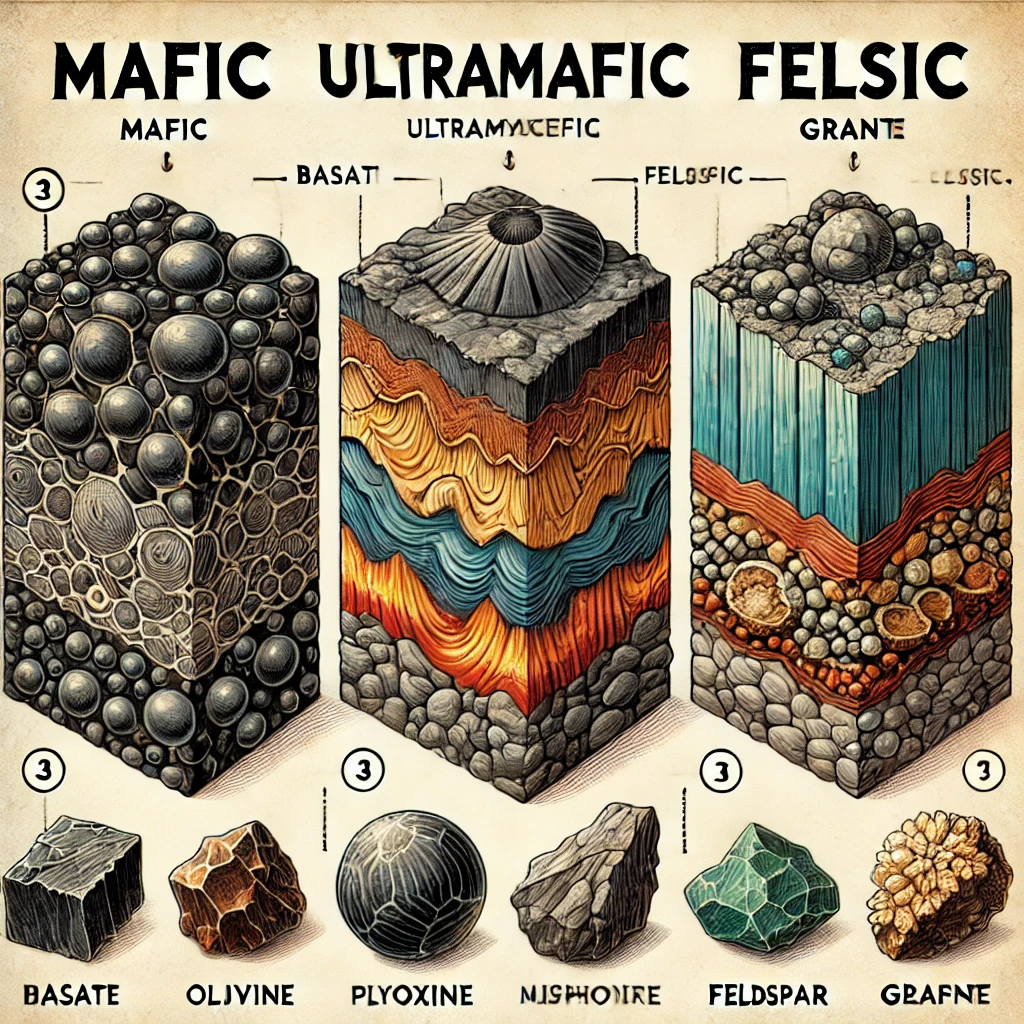
In geology, igneous rocks are classified based on their mineral composition and the relative abundance of elements such as silicon (Si), oxygen (O), aluminum (Al), magnesium (Mg), iron (Fe), calcium (Ca), sodium (Na), and potassium (K). The three major classifications of igneous rocks are mafic, ultramafic, and felsic. These terms describe the chemical makeup of the rocks and the minerals that form them, influencing their color, density, and formation process.
1. Mafic Rocks and Minerals
Definition
Mafic rocks are igneous rocks that contain moderate amounts of silica and are rich in magnesium (Mg) and iron (Fe). They form from magma that originates in the Earth’s upper mantle and are commonly found in oceanic crust.
Origin of the Term
The term mafic is derived from “MA” (magnesium) and “FIC” (from Ferric (Latin for iron).
Composition
Mafic rocks contain relatively high amounts of calcium, sodium, magnesium, and iron, but lower amounts of silica compared to felsic rocks.
Appearance
- Color: Dark-colored (black, green, or dark gray)
- Density: High specific gravity (>3.0)
Common Mafic Minerals
- Olivine
- Pyroxene
- Amphibole
- Biotite mica
- Plagioclase feldspar
Common Mafic Rocks
- Basalt (extrusive) – A fine-grained, dark-colored volcanic rock that makes up most of the oceanic crust.
- Gabbro (intrusive) – The coarse-grained equivalent of basalt, found in plutonic environments.
Formation
Mafic magmas are typically produced at mid-ocean ridges (spreading centers) where mantle material partially melts and rises to form new oceanic crust.
2. Ultramafic Rocks and Minerals
Definition
Ultramafic rocks contain very low amounts of silica and are extremely rich in magnesium and iron. They are the primary constituents of the Earth’s mantle and are rarely found at the Earth’s surface except in tectonic zones.
Difference from Mafic Rocks
- Mafic rocks contain moderate silica content.
- Ultramafic rocks contain very little silica and an even greater concentration of magnesium and iron.
Appearance
- Color: Very dark or greenish due to the high olivine content.
- Density: Extremely high specific gravity (>3.3)
Common Ultramafic Minerals
- Olivine
- Pyroxene
Common Ultramafic Rocks
- Peridotite – The dominant rock type of the Earth’s mantle.
- Komatiite – A rare, ancient volcanic rock found in early Earth’s crust.
Formation
Ultramafic rocks are found in the Earth’s mantle and can be exposed at the surface in subduction zones or mantle plumes.
3. Felsic Rocks and Minerals
Definition
Felsic rocks are rich in silicon, oxygen, aluminum, and potassium while having lower amounts of magnesium and iron. These rocks form in continental crust and are typically associated with volcanic and plutonic activity.
Origin of the Term
The term felsic comes from “FEL” (feldspar, specifically potassium feldspar) and “SIC” (silica, referring to its high silica content).
Composition
Felsic rocks contain high amounts of silica, aluminum, potassium, and sodium, making them lighter in color and lower in density compared to mafic and ultramafic rocks.
Appearance
- Color: Light-colored (white, pink, or light gray)
- Density: Low specific gravity (<3.0)
Common Felsic Minerals
- Quartz
- Muscovite mica
- Orthoclase feldspar
Common Felsic Rocks
- Granite (intrusive) – Forms from slow-cooling felsic magma, producing large mineral crystals.
- Rhyolite (extrusive) – The fine-grained volcanic equivalent of granite.
Formation
Felsic magmas typically form in continental crust, often associated with plate subduction zones and granitic intrusions.
Comparison of Mafic, Ultramafic, and Felsic Rocks
| Rock Type | Silica Content | Magnesium & Iron | Color | Density | Common Minerals | Common Rocks | Formation |
|---|---|---|---|---|---|---|---|
| Mafic | Moderate | High | Dark | >3.0 | Olivine, Pyroxene, Amphibole, Biotite, Plagioclase Feldspar | Basalt, Gabbro | Mid-ocean ridges, upper mantle |
| Ultramafic | Very Low | Very High | Very Dark / Greenish | >3.3 | Olivine, Pyroxene | Peridotite, Komatiite | Earth’s mantle |
| Felsic | High | Low | Light | <3.0 | Quartz, Muscovite, Orthoclase Feldspar | Granite, Rhyolite | Continental crust, subduction zones |
Conclusion
The classification of igneous rocks into mafic, ultramafic, and felsic is essential for understanding the Earth’s geology. Each type has unique mineral compositions, densities, and formation processes. Mafic and ultramafic rocks are commonly associated with the Earth’s mantle and oceanic crust, whereas felsic rocks primarily form in the continental crust. These distinctions help geologists study the Earth’s interior processes, plate tectonics, and the history of volcanic activity.
Keywords
Mafic, Ultramafic, Felsic, Igneous Rocks, Silicate Minerals, Magnesium, Iron, Silica, Basalt, Gabbro, Granite, Peridotite, Quartz, Mantle, Spreading Centers, Subduction Zones, Continental Crust.




Leave a comment