
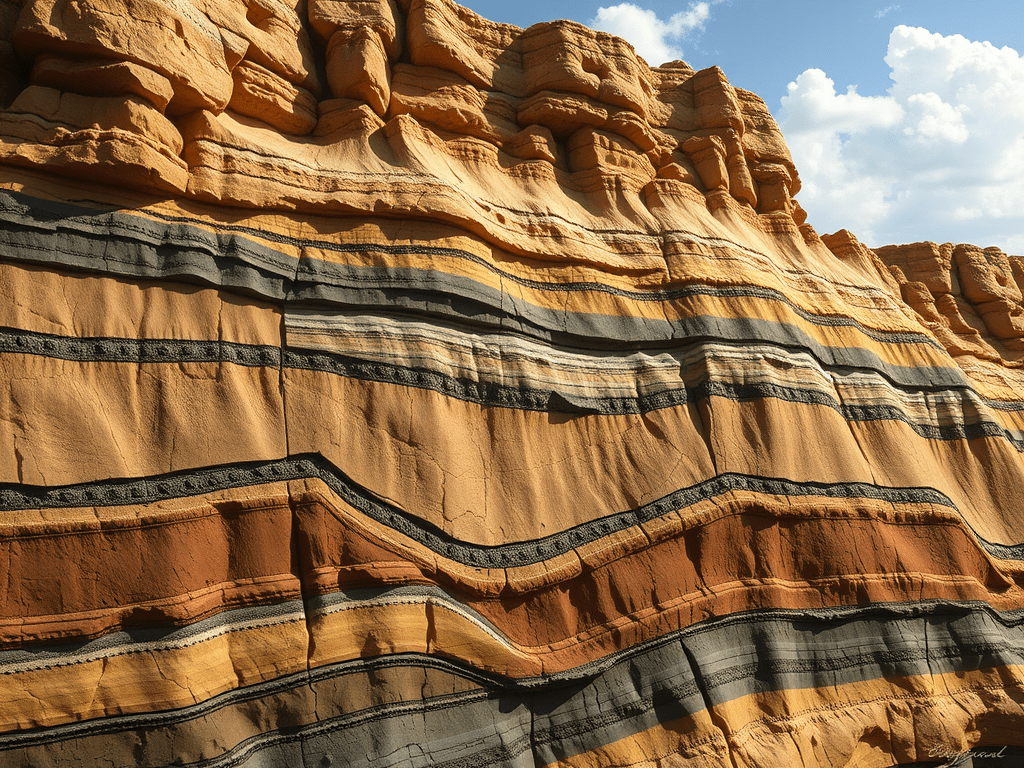
Sandstone uranium deposits are mineralizations hosted in medium- to coarse-grained sandstones that were deposited in continental fluvial or marginal marine environments. These deposits are typically associated with interbedded impermeable shale or mudstone units, which often lie immediately above and below the mineralized sandstone.
Uranium is precipitated under reducing conditions, which can be induced by several agents present in the sandstone. These reducing agents include:
- Carbonaceous Materials: Such as detrital plant debris, amorphous humate, and marine algae.
- Sulphides: For example, pyrite and hydrogen sulfide (H₂S).
- Hydrocarbons: Including petroleum.
- Interbedded Basic Volcanics: Enriched with ferro-magnesian minerals like chlorite.
Sub-types of Sandstone Uranium Deposits
These deposits are generally classified into five main sub-types, which can sometimes occur in combination:
- Basal Channel Deposits:
Characterized by wide channels filled with permeable sediments.
Examples: Dalur and Khiagda (Russia); Beverley and Honeymoon (South Australia). - Tabular Deposits:
These are irregular, elongate, lenticular bodies that run parallel to the depositional trend. They commonly occur in palaeochannels incised into underlying basement rocks.
Examples: Akouta, Arlit, and Imouraren (Niger); Hamr-Stráž pod Ralskem (Czech Republic); various deposits on the Colorado Plateau (USA). - Roll-front Deposits:
These deposits form arcuate bodies of mineralization that crosscut the sandstone bedding, often within palaeochannels.
Examples: Budenovskoye, Tortkuduk, Moynkum, Inkai, and Mynkuduk (Kazakhstan); Crow Butte and Smith Ranch (USA). - Tectonic/Lithologic Deposits:
Occurring in sandstones adjacent to permeable fault zones.
Examples: Deposits in the Lodève District (France) and the Franceville Basin (Gabon). - Mafic Dykes or Sills in Proterozoic Sandstones:
Examples: Matoush (Canada) and Westmoreland (Australia).
Among these, the three primary types—Roll-front, Tabular, and Tectonic/Lithologic deposits—are most commonly observed in the field.
An idealized cross-section of a sandstone-hosted uranium roll-front deposit illustrates these features clearly (Cyclone Uranium Corporation, 2012).






Leave a comment